The Art Nouveau Dome of Galeries Lafayette Haussmann
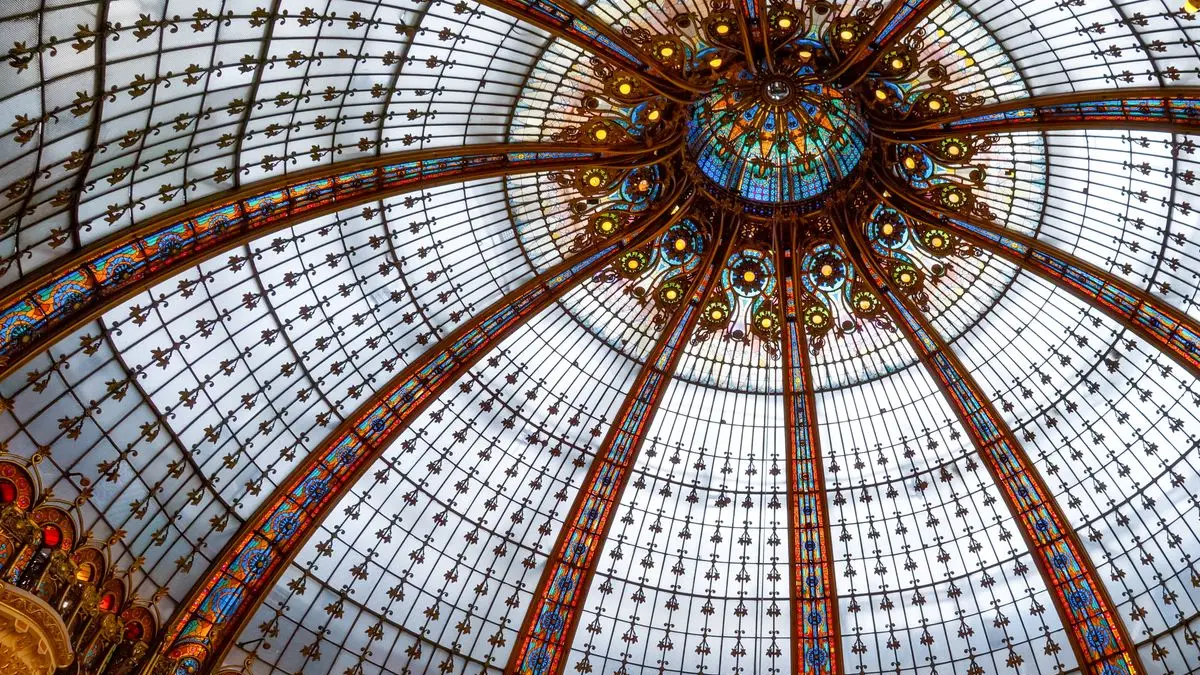
In the heart of the Opéra district, a vast glass dome pours coloured light down onto the shop floors below. Unveiled in 1912, the cupola of Galeries Lafayette Haussmann remains one of the most breathtaking Art Nouveau masterpieces in Paris. Here is how to read it, admire it and carry on all the way up to the roof.
A 1912 glass dome above Boulevard Haussmann
When Galeries Lafayette opened its flagship store on Boulevard Haussmann in 1912, the architect Ferdinand Chanut, working alongside the master glassmaker Jacques Grüber, designed a dome meant to draw daylight deep into the building. In an age when electric lighting was still in its infancy, the glass ceiling was far more than decoration: it flooded the tiered galleries around the central atrium with natural light.
Rising some thirty metres above the ground floor, the dome unfolds like a sky of amber, blue and gold glass. Its neo-Byzantine silhouette, all curves and pendentives, recalls the great Eastern basilicas as much as the exhibition palaces that had dazzled Paris a few years earlier during the world fairs.
The department store was conceived as a theatre of shopping, a place to stroll as much as to buy. The dome is the showstopper, a hanging vault that Parisians and travellers alike come to admire with their heads tilted back, exactly as one gazes up at a cathedral ceiling.
Stained glass on a steel frame: an engineering feat
The dome brings together two worlds: the lightness of coloured glass and the strength of industrial steel. The whole revolution of the grand magasin rests on this mastery of metal framing, inherited from the market halls and the great Parisian stations such as Saint-Lazare and Gare du Nord. Here the steel skeleton forms a delicate lattice that almost vanishes behind the colours.
The glazing itself is worked with floral motifs, scrolls and arabesques that are pure Art Nouveau, the movement that around 1900 sought to reconcile art and industry. Warm tones dominate, so that on sunny afternoons the light falling to the floor takes on a burnished, ever-shifting glow that shifts throughout the day.
Wrought iron: the soul of the 1900 style
You cannot understand the dome without looking towards the balustrades and railings that frame it. The balconies ripple in scrolls of wrought iron, in the same floral language you find on Hector Guimard’s Métro entrances, another signature of Parisian Art Nouveau. Every rail is a piece of decorative ironwork where the curving line triumphs over the right angle.
This dialogue between glass and metal tells the story of the craft workshops of the early twentieth century, when wrought iron was an art in its own right. Visitors drawn to this heritage can extend their curiosity towards this wrought-iron craftsmanship, still alive today in the hands of artisans who keep these gestures going.
From the monumental staircase railing to the details of the light fittings, everything works towards a sense of unity: the store is not a mere collection of departments but a total work of art in which architecture, light and metal answer one another.
The free rooftop: Paris and the Opéra at your feet
After the dome, head up to the rooftop terrace, which is free to visit. From this platform the view sweeps across much of Paris: the green copper roof and gilded statues of Charles Garnier’s Opéra just next door, the Eiffel Tower on the horizon, the Sacré-Cœur crowning Montmartre, and rows of Haussmannian rooftops stretching as far as the eye can see.
The rooftop is one of the most generous and least known viewpoints in the district. At sunset, as the city lights come on, the terrace offers a spectacle that few Parisian belvederes can match, with no ticket and no queue.
Do check the opening hours in real time before you climb, as they vary with the season and the store’s events. The terrace may close temporarily in bad weather.
Extending your walk through the Opéra district
The dome is only a gateway to a district of rare richness. A stone’s throw away, the Opéra Garnier reveals its grand staircase and the ceiling painted by Marc Chagall in 1964, a whirl of colour suspended above the auditorium. The Musée Grévin, the Grands Boulevards and their covered passages complete a stroll through the Paris of the Belle Époque.
For elegance, Place Vendôme and its jewellers are only a few minutes on foot, while the Saint-Lazare and Gare du Nord stations connect the district easily with the rest of France and Europe. The Métro serves Opéra via lines 3, 7, 8 and 9, making it an ideal base for exploring the capital.
Practical tips for admiring the dome
The best time to see the glass ceiling is mid-morning on a sunny day, when the light strikes the stained glass head-on and casts its colours right down to the floor of the great hall. In the late afternoon the tones turn softer and more golden, ideal for photography. If you can, avoid busy Saturdays, when the crowds make quiet contemplation harder.
Entry to the store and the dome is free, with no ticket required, and so is the climb up to the rooftop terrace. To take in the dome as a whole, stand in the centre of the hall beneath the light well, then go up a floor or two to see it at balcony level and appreciate the ironwork in detail.
Allow a good hour to combine the glass dome, the panoramic terrace and a wander through the departments. The district is easily explored on foot, and there is nothing to stop you carrying on to the nearby Opéra Garnier for a morning devoted entirely to the Paris of the Belle Époque.