Visiting the Palais Garnier: A Complete Guide to the Paris Opera
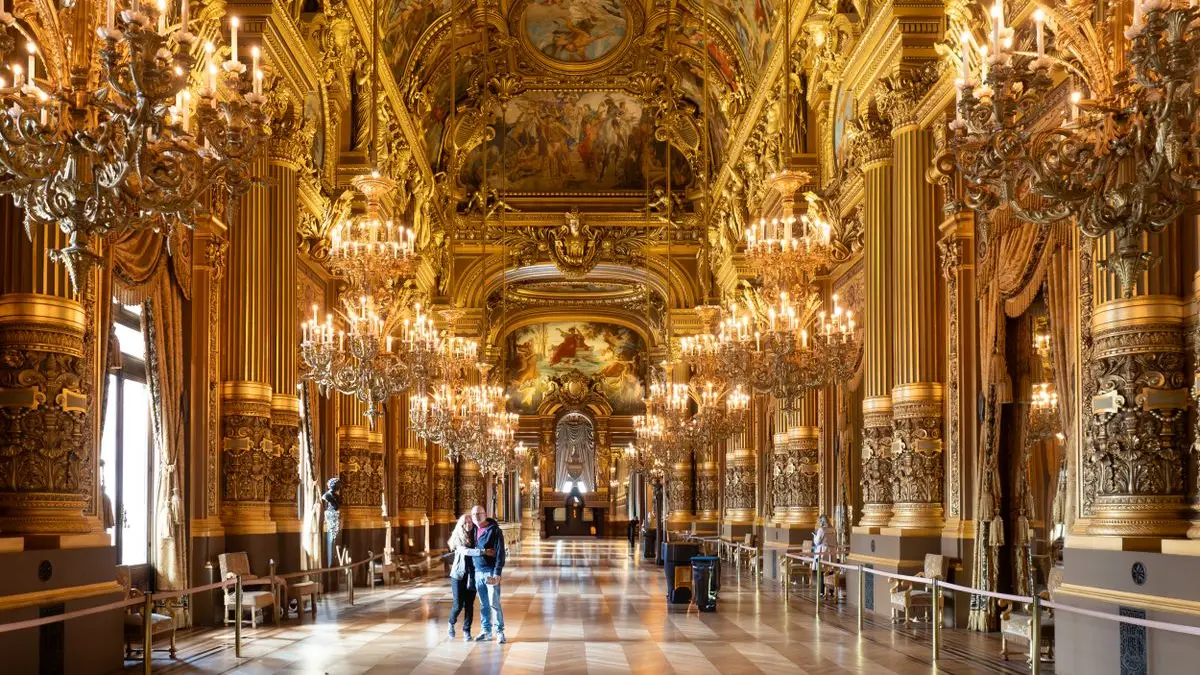
The Palais Garnier is far more than a concert hall: it is a palace you visit for its own sake. From its theatrical Grand Staircase to the ceiling painted by Chagall, here is how to plan your visit, choose your tickets and see the very best of this Second Empire jewel in the 9th arrondissement.
Tickets, Opening Hours and Getting There
The Palais Garnier opens to visitors on most days, except during matinée performances and a handful of exceptional closures. Opening hours shift with the season, running longer in summer and shorter through the rest of the year, so it is wise to check the day’s times before you set off. Note that the ticket desk usually closes about an hour before the building itself.
You can buy your ticket at the visitors’ entrance on rue Scribe or online to skip the queue. Prices vary by the option you choose and by season, and reduced conditions apply to young people, students and under-eighteens, so check the current rates in real time before you come. The opera sits in the heart of the district, served by Opéra station on Métro lines 3, 7 and 8, and just minutes from the Saint-Lazare and Gare du Nord rail terminals.
Two formats are available: a self-guided visit at your own pace, and a guided tour led by a lecturer. The first suits those who like to wander and read the labels; the second unlocks spaces and stories you would rarely uncover on your own.
Self-Guided or Guided: Which to Choose
On a self-guided visit you explore the great public spaces of the palace: the Grand Staircase, the foyers, the rotunda and, when the schedule allows, a glimpse of the auditorium from a box. A multilingual audio guide adds commentary on the architecture and history of the place. It is the ideal choice for a first discovery or a family outing.
The guided tour, offered at set times, lasts around ninety minutes. The lecturer recounts the making of the building, the life of the company and the legends that cling to the walls, including the one that inspired The Phantom of the Opera. It sometimes grants access to rooms closed to self-guided visitors, subject to rehearsals and the technical demands of the day.
Our advice: if time is short, a self-guided visit is enough to feel the magic of the place. But for lovers of history and architecture, a guided tour turns the walk into a genuine journey through the Paris of Napoleon III.
The Grand Staircase: A Theatre Within a Theatre
The moment you step past the vestibule, the Grand Staircase steals the show. Cut from marbles of contrasting colours, it sweeps upward in a double flight towards the foyers and the auditorium. Charles Garnier conceived it as a stage in its own right: in the nineteenth century, high society came as much to be seen as to hear the music, and this staircase was the backdrop to that social spectacle.
Look up to the vaulted ceiling, painted and framed by balconies from which onlookers could gaze down on those climbing and descending. Torchères, columns and cunning perspectives create a permanent piece of theatre. Here you grasp Garnier’s own ambition: a place where the public would be both actor and spectator.
Pause halfway up: the sweeping view down over the entrance hall, with its currents of visitors and its softened light, is one of the finest vantage points in the whole building.
The Chagall Ceiling and the Auditorium
Beneath the great bronze-and-crystal chandelier of the Italian-style auditorium lies one of the palace’s treasures: the ceiling painted by Marc Chagall and unveiled in 1964. Commissioned by the minister André Malraux, this vast circle of colour pays tribute to fourteen composers, from Mozart to Ravel, through dreamlike scenes of flowers, angels and Paris landmarks.
This modern ceiling, long a subject of controversy, crowns a resolutely nineteenth-century setting of red velvet, gilding, caryatids and horseshoe-shaped tiers. The contrast between Chagall’s luminous fresco and the sumptuous Second Empire décor is exactly what makes the room so singular. When the auditorium is open to visitors, you admire it from a box, for a few minutes out of time.
Access to the auditorium depends on rehearsals and programming, and is never guaranteed. That is one more reason to choose your time slot with care and, where possible, to check the day’s conditions before you arrive.
The Grand Foyer: The Opera’s Hall of Mirrors
Nearly sixty metres long, the Grand Foyer was designed by Garnier as a promenade gallery worthy of a royal château. Mirrors, gilding, ceilings painted by Paul Baudry and glittering chandeliers form a dazzling perspective often compared to the Hall of Mirrors at Versailles. Audiences gathered here at the interval to be seen, to converse and to prolong the evening.
Step out onto the loggia: on the avenue de l’Opéra side it offers a view straight down to the Louvre, a perspective willed by Haussmann himself. The neighbouring salons, dressed in mosaics and hangings, complete this lavish route where every detail speaks of the refinement of imperial Paris.
The Grand Foyer is the climax of the self-guided visit. Take the time to walk its full length, to lean close to the mirrors and to look up at the ceilings: this is where the Palais Garnier fully reveals its ambition to be a palace.
Charles Garnier and the Story of the Building
The story of the Palais Garnier begins in 1861, when a young and still unknown architect, Charles Garnier, won the competition launched under Napoleon III to give Paris a new opera house. Legend has it that the Empress Eugénie, puzzled by the style of the project, asked what kind it was; Garnier is said to have replied that it was the Napoleon III style.
The works, slowed by the discovery of an underground water table beneath the foundations, by the war of 1870 and by the fall of the Empire, dragged on for fourteen years. The building was finally inaugurated in 1875, under the Third Republic. Its dazzling façade, its statues, its green dome and its gilded pediment at once made it one of the emblems of the new Haussmannian Paris.
Today, set at the heart of a district devoted to shopping and spectacle, between the Galeries Lafayette and the Grands Boulevards, the Palais Garnier remains the symbol of a golden age. To visit it is to step into the dream of an architect who wanted to give Paris not a mere hall, but a palace of pleasure and the arts.