Grands Boulevards Paris: History and Walking Tour
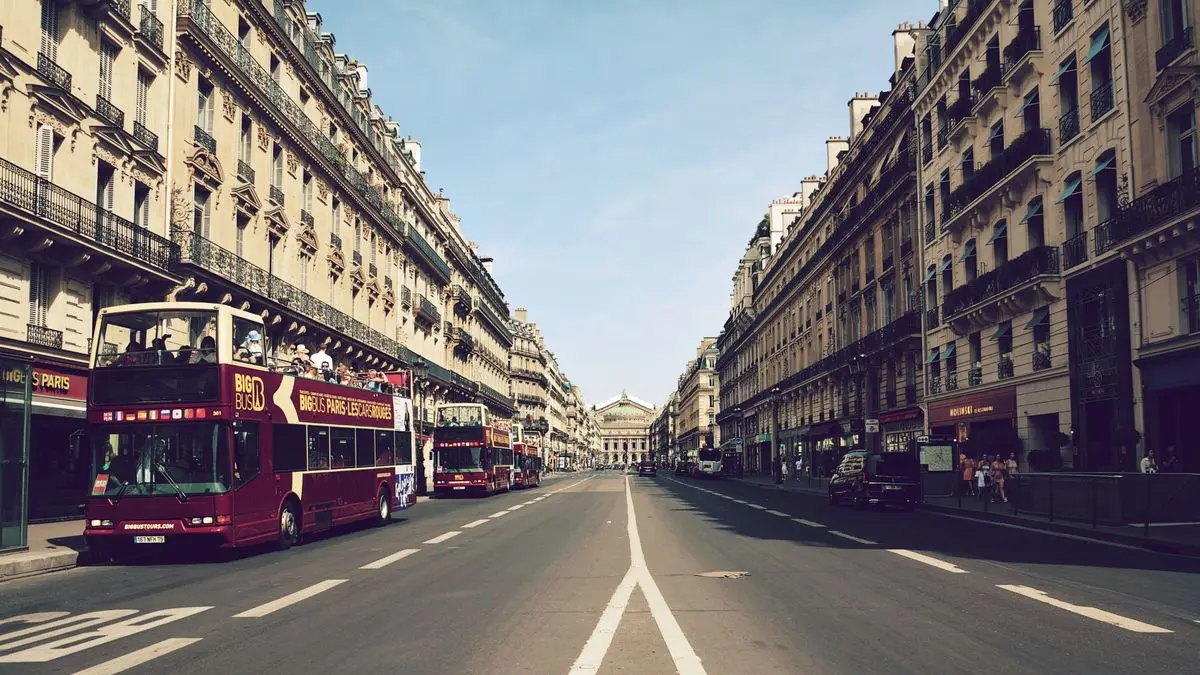
From boulevards laid out under Louis XIV to the glowing marquees of today, this legendary strip tells three centuries of Parisian pleasure. Theatres, cafés, covered arcades and music halls set an unmistakable scene. Follow our guide for a walk through time, from La Madeleine to the Grands Boulevards.
Origins: from city walls to a fashionable promenade
Contrary to popular belief, the Grands Boulevards were not the work of Baron Haussmann. Their line dates back to Louis XIV: in the 1670s the Sun King had the redundant medieval ramparts pulled down and replaced with a broad, tree-lined avenue. The very word boulevard comes from the Dutch bolwerk, meaning bulwark or rampart. Elm trees were planted, and fashionable Paris came to take the air by carriage.
Running from La Madeleine to the Bastille, this green belt quickly became the place to be seen. Through the eighteenth century, cafés, puppet theatres and open-air taverns multiplied. Each stretch took on its own character: the Boulevard des Italiens was the most elegant, the Boulevard Montmartre more popular, and the Boulevard du Temple earned its nickname as the boulevard of crime for its blood-soaked melodramas.
Haussmann’s avenue and the triumph of the Opéra
Under the Second Empire, Haussmann extended and regularised the whole ensemble. He drove the Avenue de l’Opéra through the old quarter, opened up grand perspectives and imposed his signature apartment blocks, with their dressed stone, running balconies and zinc roofs. At the head of the new avenue rose the masterpiece of Charles Garnier.
Inaugurated in 1875, the Palais Garnier became the emblem of the district. Its sweeping staircase, gilded foyer and, later, the ceiling painted by Marc Chagall in 1964 make it one of the most visited monuments in Paris. Nearby, the great department stores flourished: on Boulevard Haussmann, the Galeries Lafayette were crowned in 1912 with an Art Nouveau dome of glass and steel that still draws the crowds.
The district was booming commercially, too. Nearby, the Gare Saint-Lazare poured out crowds of travellers each day, while the Printemps store, neighbour to the Galeries Lafayette on Boulevard Haussmann, matched it for architectural daring. Glass roofs, lifts and sumptuous window displays invented a whole new way to browse and to shop, at the heart of a Paris that dreamed of being modern.
Theatres and music halls: Olympia, Folies Bergère, Mogador
Above all, the Grands Boulevards were a stage. The Théâtre des Variétés, opened in 1807 on Boulevard Montmartre, kept the vaudeville tradition alive. But it was during the Belle Époque that the quarter became the world capital of entertainment.
In 1893, Joseph Oller founded the Olympia on Boulevard des Capucines — the oldest music hall in Paris still in use, and later home to the biggest names in song. A little further north, the Folies Bergère, open since 1869, invented the lavish revue of feathers and staircases. After the First World War, the Théâtre Mogador, opened in 1919 and modelled on London’s music halls, completed this golden triangle of the Parisian stage.
Cafés, the press and the birth of cinema
Between shows, everyone met at the café. The Café de la Paix, opened in 1862 opposite the Opéra, remains the emblematic address where artists, journalists and travellers still cross paths. In those days the boulevards housed the newsrooms of the leading papers, and le tout-Paris was made and unmade on the terraces.
This is also where the seventh art was born. On 28 December 1895, in the Salon Indien of the Grand Café at 14 Boulevard des Capucines, the Lumière brothers held the first paying film screening in history. Decades later, in 1932, the Grand Rex opened on Boulevard Poissonnière as the city’s largest cinema — a veritable picture palace, now a listed historic monument.
Cinema never left the boulevards after that. Between the wars, picture houses and theatres shared the same pavement, and glowing signs turned the night into a permanent show. That excitement left the quarter with its lasting taste for the image and the stage, still felt today as you move from one auditorium to the next.
Nightlife, from the Belle Époque to today
Lit first by gas and then by electricity, the Grands Boulevards were among the first illuminated streets in Europe. After dark they drew a cosmopolitan crowd to stroll, dine and applaud. The covered arcades — the Passage des Panoramas (1800) and the Passage Jouffroy among them — carried the promenade on under glass, past shops, restaurants and the famous Musée Grévin waxworks, opened in 1882.
The quarter has kept that after-dark energy. Theatres sell out, historic brasseries serve late, and cinemas sit alongside cocktail bars and concert halls. By day you shop in the great stores; by night you rediscover the festive spirit of the boulevardiers of old.
A walking route: from La Madeleine to the arcades
Start at La Madeleine and head east. Cross the Place de l’Opéra to admire Garnier’s façade, then treat yourself to a pause at the Café de la Paix. Carry on along the Boulevard des Capucines, where a plaque marks the Lumière brothers’ first screening.
Continue towards the Boulevard des Italiens and the Boulevard Montmartre: slip into the Passage des Panoramas, take a detour to the Musée Grévin, then reach the Passage Jouffroy and the Passage Verdeau, a paradise for booksellers and collectors. Allow a good half-day to enjoy it all.
For getting around, the Madeleine, Opéra, Richelieu-Drouot and Grands Boulevards stations — served by métro lines 3, 7, 8 and 9 — punctuate the route. There is nothing to stop you doing it in stages, following the shows and the café terraces as you go.