Getting Around the Opéra District by Métro and on Foot
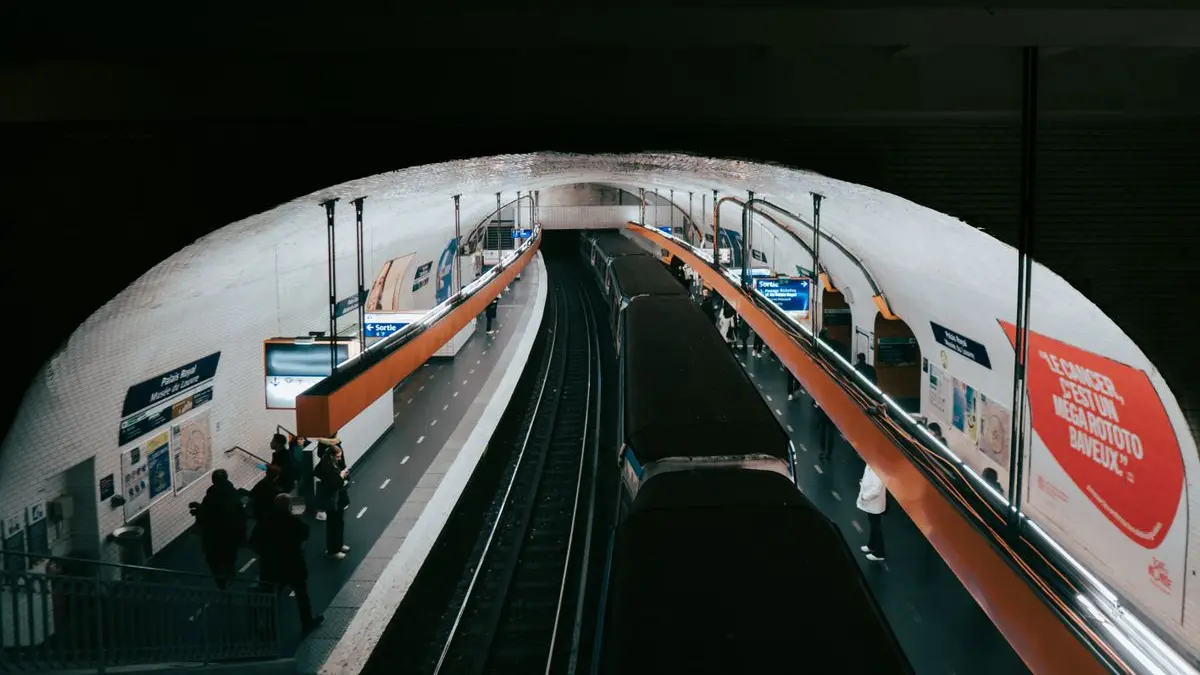
The Opéra district is one of the best-connected corners of Paris. Four métro lines cross beneath your feet, the Grands Boulevards radiate all around, and almost everything is within walking distance. Here is how to master this dense network, moving through the 9th arrondissement and reaching the rest of the city without ever wasting time or losing your bearings.
Four métro lines under the Boulevard Haussmann
The heart of the district sits on a rare junction: lines 3, 7, 8 and 9 all cross within a few hundred metres of one another. Opéra station, beneath the square of the same name, brings together lines 3, 7 and 8, right at the foot of Charles Garnier’s golden dome. It is the handiest launch pad for heading either east or west across Paris.
Line 3 runs towards République and Père-Lachaise on one side, and towards Saint-Lazare and the western suburbs on the other. Line 7 drops down to the Palais-Royal, the Louvre and the national library before climbing back up to the Gare de l’Est and Gare du Nord. Line 8 links the Opéra to the Bastille and the Madeleine, while line 9 crosses the district through Chaussée d’Antin – La Fayette on its way to the Champs-Élysées and the Trocadéro.
In practice, from the Opéra you can reach most of the city’s great sights on a single line or with just one change. The Louvre, the Arc de Triomphe, the Marais, the Latin Quarter: all are around twenty minutes away, map in hand or app open. Few visitors ever need a taxi for sightseeing here.
Three stations worth knowing near your hotel
Opéra station, the most central, serves the Boulevard des Capucines and the Avenue de l’Opéra. Large and busy, it is your gateway to lines 3, 7 and 8. Its corridors also lead towards the RER A and neighbouring stops, so you can reach La Défense or Disneyland Paris with barely a change of train.
Chaussée d’Antin – La Fayette, on lines 7 and 9, lies directly beneath the Galeries Lafayette, whose stained-glass dome has crowned the store since 1912. It is the shoppers’ station, but also a valuable interchange towards the Bourse and the south-west of the city. One exit opens straight onto the Boulevard Haussmann.
Havre-Caumartin, finally, connects lines 3 and 9 a stone’s throw from the Gare Saint-Lazare, one of the busiest stations in Europe. From here you can reach the western suburbs, Versailles or Normandy after a short walk to the Transilien platforms. Together, these three stations form a triangle that covers most of your everyday journeys.
The Navigo pass, your best ally
For anyone staying several days, the Navigo pass is the most flexible answer. Loadable by the week or as a set of digital trips, it opens the métro, the RER, the bus and the tram in a single gesture. You validate it by tapping the card against the gate, without ever fishing for a paper ticket at the bottom of a pocket.
The Paris network now runs on contactless fares, which can be loaded onto a card or straight onto a compatible smartphone. Prices change from time to time, so check the current day or week options in real time; they often work out cheaper than buying trip by trip once you start moving around a lot.
A tip worth remembering: keep your ticket to hand until you leave the station, as switching between the métro and the RER sometimes means passing through a second set of gates. And always tap in, even when merely changing lines. It is the rule, and the surest way to avoid any awkwardness during an inspection.
Vélib’ bikes and gentle ways to travel
The district has plenty of Vélib’ stations, the Paris bike-sharing scheme, offering both pedal and electric machines. Picking up a bike on the Boulevard Haussmann to glide towards the banks of the Seine or the Parc Monceau is a real pleasure during quiet hours, when the traffic eases and the cycle lanes, much expanded in recent years, come into their own.
The electric bikes make light work of the hills, especially on the climb up towards Montmartre and Pigalle. You unlock the machine through the app, ride, then dock it at the nearest stand to your destination. Always check availability in real time on the app, as the most central stations empty quickly at rush hour.
For short hops, a scooter or simply walking is often the most agreeable choice. The 9th arrondissement lends itself beautifully to strolling: from one street to the next you drift from grand department stores to covered passages without ever needing to head underground.
Almost everything is within walking distance
The great blessing of the Opéra district is the sheer density of sights within reach of a good pair of shoes. From the Place de l’Opéra, the Madeleine and the Place Vendôme are about ten minutes’ walk away, as are the Galeries Lafayette and Printemps, lined up along the Boulevard Haussmann. The Musée Grévin, with its waxworks, is only a few blocks off on the Boulevard Montmartre.
The covered passages, those nineteenth-century arcades sheltered under glass roofs, form a walking route in their own right. From the Passage des Panoramas to the Passage Jouffroy you thread through a succession of old shops, second-hand booksellers and tea rooms, safe from both rain and sun. It is one of the loveliest ways to discover the area without ever setting foot on the métro.
To reach the Louvre or the Tuileries garden, allow around a quarter of an hour on foot along the Avenue de l’Opéra, drawn dead straight towards the Seine. Walking helps you grasp the layout: the Grands Boulevards to the east, the Saint-Lazare and Nord stations to the north, and that ruler-straight avenue diving towards the river. Once that mental map settles in, you will move through Paris like a regular.