The Art Blacksmith, Guardian of Parisian Facades
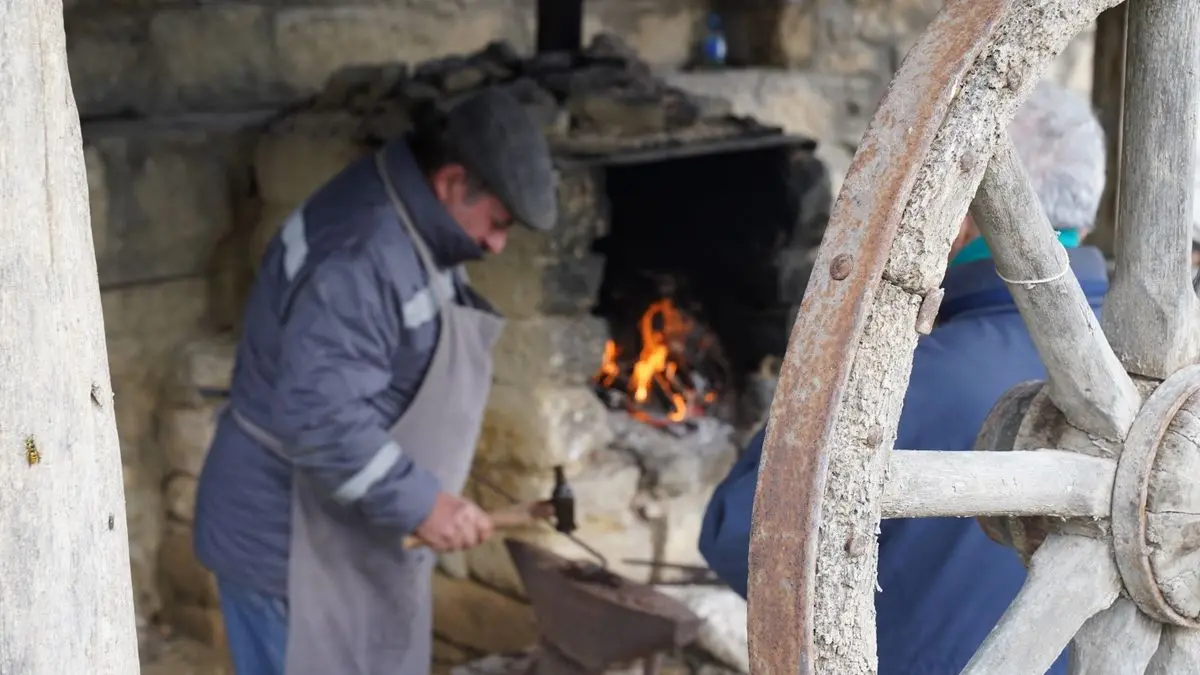
Look up anywhere near the Opéra and you will see iron everywhere: ornate balcony railings, glass-and-metal canopies, staircases rising into the Haussmann floors above. Behind every curve stands an art blacksmith, a forge and a set of gestures handed down over centuries. Here is why that craft still matters to Paris.
The Forge: the Beating Heart of the Workshop
It all begins with fire. In the blacksmith's workshop the forge heats iron to somewhere between 900 and 1200 degrees, until it shifts from dull red to bright orange-yellow. It is this colour, not a thermometer, that tells the craftsman the exact moment the metal turns workable. Too cold and it cracks; too hot and it burns and loses its cohesion. The smith's trained eye, sharpened over years, replaces the instrument.
Around the forge sits an unchanging set of tools: the massive anvil on which the iron is struck; the hand hammer and the sledge; the tongs that grip the glowing bar; the quenching bath of water or oil. Little has fundamentally changed since the Middle Ages, apart from the electric blower and, occasionally, a power hammer to rough out heavier pieces.
The rhythm of the work is set by heat. The blacksmith has only a few seconds, between drawing the bar from the fire and its cooling, to shape the metal. Every move must therefore be anticipated, rehearsed and precise. It is this pressure of time that makes ironwork as physical as it is mental.
Gestures Passed from Hand to Hand
Drawing out, upsetting, bending, splitting, hot-punching, riveting: the blacksmith's vocabulary describes a choreography of gestures that can only be learned beside a master. Drawing out lengthens and thins the bar; upsetting does the reverse, gathering it into a swelling; bending gives it its scrolls. The tight, snail-like curl at the end of a classic railing demands perfect regularity.
Assembly is traditionally done without modern welding: through riveted tenons, tightening collars, or forge welding, in which two pieces heated to white are hammered together until they become a single metal. These joints, whether hidden or deliberately decorative, reveal the true level of the craftsman.
In France this knowledge is still passed on through apprenticeship and the compagnonnage tradition, where the young worker spends years watching, imitating and finally inventing. To understand the depth of this heritage in full, it is worth reading about the craft of the art blacksmith and the training routes that keep the gesture alive.
Balconies, Canopies and Staircases on Show
The art blacksmith works above all for architecture. The most visible pieces are balcony railings, that lacework of iron which gives rhythm to the Haussmann buildings of Boulevard Haussmann and the Grands Boulevards. Each principal floor is marked by a running balcony whose design follows composition rules codified during the nineteenth century.
Canopies, the glass-and-metal awnings that shelter doorways, form another great chapter. You meet them in front of private mansions, theatres and the covered passages of the district. Their iron frame, at once solid and airy, must carry the glass while drawing Art Nouveau arabesques or the cleaner geometry of Art Deco.
Indoors, the staircase railing is the masterpiece. It accompanies your climb, invites the hand, and must look beautiful from every angle. A large railing can call for hundreds of hours of forging and fitting, each baluster shaped, bent and assembled by hand.
Iron, the Memory of Opéra's Facades
The Opéra district is an open book on the art of metal. The Opéra Garnier, completed in 1875 by Charles Garnier, blends bronze, copper and wrought iron down to its gates and lanterns; inside, the ceiling painted by Marc Chagall in 1964 crowns a decor where metal plays a part everywhere. A few steps away, the Galeries Lafayette on Boulevard Haussmann have displayed their famous stained-glass dome since 1912, carried by a metal frame that is a feat of engineering as much as of ironwork.
All around, the nineteenth-century covered passages, with their glass roofs, slender columns and iron balustrades, remind us that Paris was a capital of architectural metal. The Saint-Lazare and Nord stations, the metro stops on lines 3, 7, 8 and 9, the Guimard-style entrances: everywhere the wrought iron tells a story both industrial and artistic.
Preserving these facades depends on blacksmiths able to restore, exactly as they were, a bent baluster, a broken scroll, a canopy eaten by time. Without this living skill, the iron heritage would decay beyond recovery.
Spotting Real Wrought Iron on a Stroll
As you wander near Place Vendôme, the Grands Boulevards or the Musée Grévin, take time to study the balconies. Genuine wrought iron shows slight irregularities: hammer marks remain readable, no two scrolls are quite identical, and the joints reveal a rivet or a collar. Cast iron, by contrast, offers perfectly repeated motifs and often feels heavier.
Look at the ends, too: a fine railing finishes with a careful curl, a sculpted start, sometimes a repoussé flower or leaf. These details, invisible to the hurried passer-by, are the craftsman's signature. They turn a simple guard rail into a piece of urban art.
It is this attention to detail that makes a stroll through the Opéra district so rewarding. Once the eye is trained, every facade becomes an open-air lesson in ironwork, and the traveller leaves with a new way of reading the city.