Ironwork and Glass Marquees: Reading the Opéra District in Iron
The Opéra quarter rewards visitors who look up. Between the Palais Garnier, the Grands Boulevards and the Galeries Lafayette, wrought iron tells a century of Parisian elegance. Follow your eye, from balcony rail to glass canopy.
The running balcony, signature of the Haussmann façade
Look up at the corner of the rue de la Chaussée d’Antin or Boulevard Haussmann and you will see, on the second floor, a line of iron running unbroken across the entire width of the building. This continuous balcony is the very grammar of the city redrawn under Baron Haussmann. It marks the piano nobile, the floor with the highest ceilings, and gives the street a steady rhythm the eye eventually stops questioning.
Look closer at the pattern. The balusters typically alternate lyre motifs, foliage scrolls and interlacing, cast in iron and then assembled. Cast iron, the great material of the industrial age, allowed a single ornament to be repeated endlessly and cheaply. It made serial beauty democratic, spread across mile upon mile of façade.
The fifth floor carries its own continuous balcony, more discreet. Between the two, simple window guards mark the lesser storeys. Once you grasp this hierarchy of iron, the building begins to speak: at a glance it tells you where the bourgeoisie of the noble floor lived and, higher up, the more modest flats beneath the roof.
The glass marquee, iron lace above the door
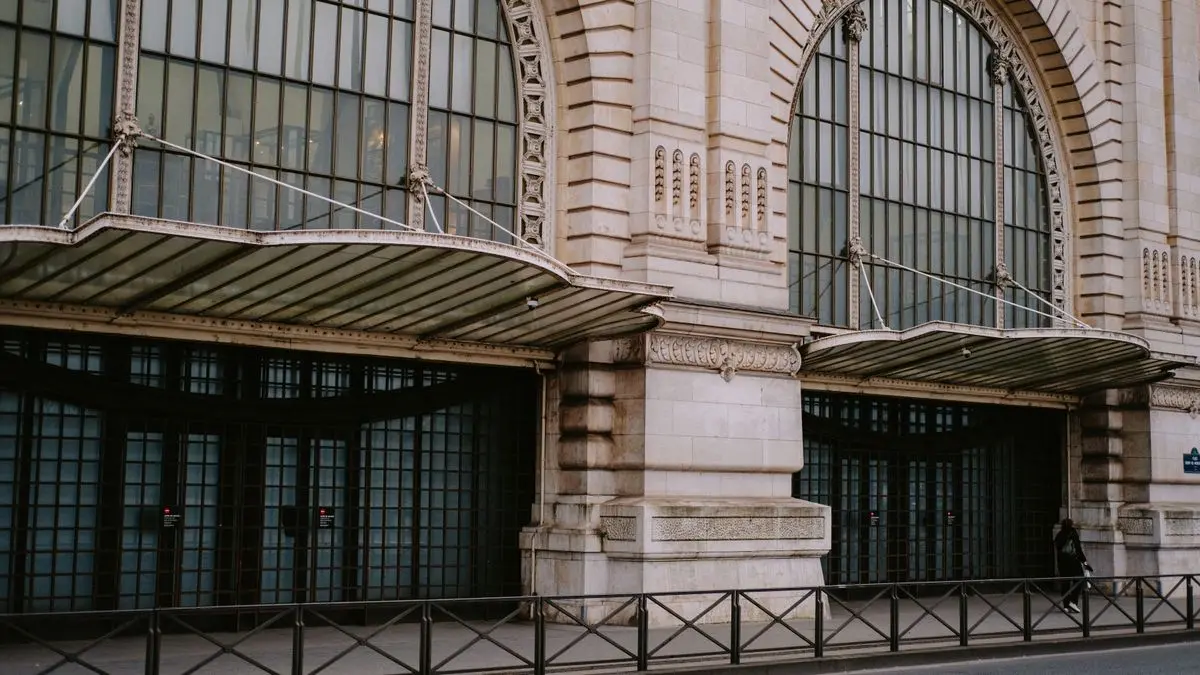
A marquee is that canopy of glass and metal set like a visor above an entrance. Born of Belle Époque craftsmanship, it sheltered those waiting for a carriage from the rain while quietly announcing a building of standing, a private mansion or a fine carriage door. Around the Opéra several survive, hanging like suspended parasols.
Study the structure: slender scrolls of hand-hammered wrought iron support a glass roof, often gently domed. The contrast is striking between the solidity of the frame and the lightness of the glass, between the rigour of the armature and the almost floral suppleness of the curves. This is the whole spirit of 1900, where engineer and artist merge. That inheritance, the tradition behind the art of the wrought-iron marquee, still passes today from workshop to workshop.
Take a moment to compare two neighbouring marquees. One favours strict symmetry, the other allows a discreet asymmetry, already a sign of Art Nouveau. Such nuances, invisible to the hurried passer-by, reveal the hand of a precise ironworker and the demands of a discerning patron.
Handrails and stairwells: iron on the rise
The drama of iron does not stop at street level. Where it is permitted, let your eye drift into the hall of a Haussmann building: the staircase rail unrolls its scrolls over several floors, a spiral you can follow all the way up to the skylight. It is often here, sheltered from the street, that the ironworker gave the best of his craft.
The motifs are freer than on the façade: tight interlacing, cartouches, stylised flowers. A wooden handrail softens the metal beneath the palm. In the finest buildings of the quarter, around the rue Le Peletier or the rue de Provence, these stairwells alone reward a quiet and respectful pause.
Do remember that these halls remain private spaces: you admire them from the threshold, never forcing a door or disturbing the residents. Parisian heritage is earned through discretion. A handful of restoration workshops, still active in the outer districts, maintain these century-old rails, replacing a time-worn baluster with an exact copy. The chain of gestures, from the smith of 1880 to the craftsman of today, has never truly been broken.
The Galeries Lafayette cupola, the apotheosis of glass and iron
All this vocabulary of iron and glass finds its climax on Boulevard Haussmann, beneath the great cupola of the Galeries Lafayette. Inaugurated in 1912 and rising some thirty metres, this neo-Byzantine dome with Art Nouveau curves pours coloured light onto the store’s circular balconies. Here the marquee has become a cathedral of commerce.
Raise your head at the centre of the main hall: the metal structure, openly displayed, carries the stained glass like a precious lattice. The same genius that hung a small canopy above a doorway is here deployed on the scale of a dome. Suddenly you understand that the cupola is not an exception but the logical culmination of an art of iron scattered throughout the district.
The store entrance and the view from the upper floors are freely accessible during opening hours; the panoramic rooftop terrace adds a close look at the zinc roofs and, in the distance, Charles Garnier’s opera house.
A walk for the eye, from the Grands Boulevards to the Opéra
To compose your own reading, start at the Chaussée d’Antin – La Fayette metro (lines 7 and 9) and climb slowly towards the Grands Boulevards. The nearby covered passages, such as the passage Jouffroy or the passage des Panoramas, extend the experience: their overhead glass roofs are direct cousins of the street marquees.
Finish facing the Palais Garnier, whose gilding and ceiling painted by Marc Chagall crown the quarter. Along the way, let your eye gather a scroll, a balcony, a forgotten glass visor: it is this slow attention that turns a simple stroll into a genuine reading of heritage. The Opéra district is not merely visited, it is deciphered.