The Must-Try Pâtisseries around the Opéra
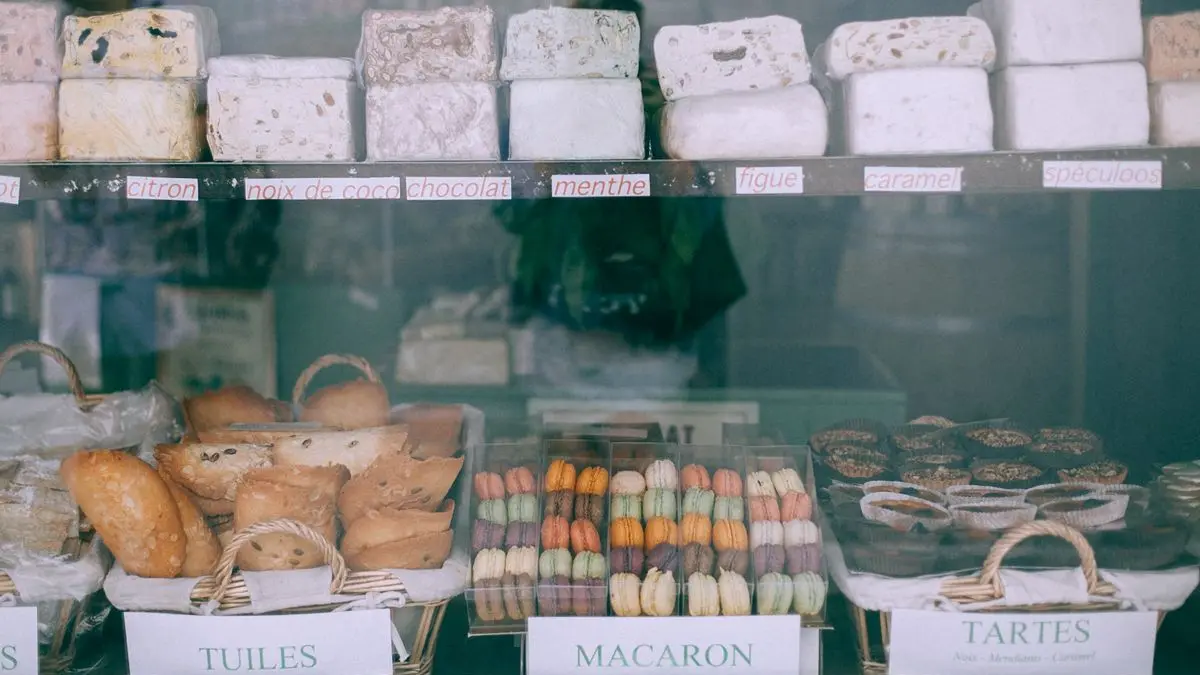
French pastry is an art in its own right, and the Opéra district is one of its finest showcases. Éclairs, mille-feuilles, Paris-Brest, macarons and saint-honoré line up behind the glass. Here is how to read a window, choose well, and carry a little of that Parisian sweetness home.
French pastry, a delicious heritage
Few countries have raised dessert to the level of art the way France has. Codified over centuries by great cooks, Parisian pastry follows a precise grammar: a dough, a cream, an assembly, a finish. Every cake tells a technique and a story, and the Opéra district, at the heart of Haussmann’s Paris, offers a rare concentration of them between the Grands Boulevards and the Boulevard Haussmann.
For the traveller, pastry is not only a treat: it is a gateway to local culture. You learn as much about Paris by studying a pastry window as by visiting a museum. The very names of the cakes evoke streets, cycle races, saints or palaces, lending the walk a flavour of history.
Around the Opéra Garnier, the houses come in several kinds: the neighbourhood pâtisserie, homely and generous, the chef’s boutique with its bold creations, and the gourmet halls of the department stores. Each has its own pleasure, and the traveller’s whole art lies in moving from one to the next as the mood takes.
The great classics to know
Begin with the essentials. The éclair, long and glazed, filled with chocolate or coffee pastry cream, is a good test: its choux pastry should be fine, its cream smooth, its glaze clean. The mille-feuille, alternating caramelised puff pastry and cream, is judged on its crispness: real puff pastry cracks under the fork without collapsing.
The Paris-Brest, a ring of choux pastry filled with a hazelnut praline cream, was invented in tribute to a bicycle race running from Paris to Brest, hence its wheel-like shape. The saint-honoré, crowned with small caramelised choux buns and filled with cream, bears the name of the patron saint of bakers and pastry-makers. Two monuments of tradition, as fine to look at as they are to eat.
Do not forget the tarts, of seasonal fruit, lemon meringue or chocolate, nor the strawberry fraisier of the warm season, nor the syrup-soaked savarin. These classics, present in almost every good house, form an ideal panorama for a first survey: taste two or three and you will quickly grasp what sets careful pastry apart from industrial production.
The macaron, between art and colour
The Parisian macaron deserves a chapter of its own. Two smooth almond-meringue shells enclose a scented ganache or cream: a delicate balance between the crunch of the shell, the softness of the centre and the intensity of the flavour. Do not confuse it with the more rustic macaroons of other French regions: the Parisian macaron is smooth, colourful, edged with its little frilled foot at the base.
The magic of the macaron lies in its palette. Vanilla, chocolate, coffee, pistachio, raspberry, salted-butter caramel, but also bolder flavours that change with the seasons: the window reads like a colour chart. It is the ideal gift to bring back, light, prettily presented in neat boxes, provided you eat it within a few days.
A tasting tip: take the macaron out of the fridge a while before eating it, so the aromas can express themselves fully. And taste several from the same house to judge the consistency of the shell and the finesse of the flavours, rather than trusting colour alone, which is often misleading.
The pleasure of the window
In Paris, the pastry window is a spectacle. The cakes sit there like jewels, each on its little card, mirror glazes, glistening fruit, flecks of gold or pistachio. Take time to stop in front of one, even without buying: it is a lesson in taste and composition, and one of the most refined free pleasures of the district.
Learn to read what a fine window says. Cakes made in reasonable quantities, renewed through the day, with clean shapes and natural colours, betray artisan work. Beware, on the contrary, of over-garish shades and static displays, often signs of standardised production. Seasonality is another clue: a true house follows the rhythm of the fruit.
The window is also an invitation to conversation. Do not hesitate to ask for advice: pastry-makers and shop staff are often proud to explain their creations, recommend the speciality of the day or the cake that travels best. It is a warm way to make contact with the local craft.
The gourmet halls of the department stores
The Opéra district is home to two institutions of Parisian retail, the Galeries Lafayette and the Printemps, both on the Boulevard Haussmann. Beyond fashion, these department stores devote entire spaces to gastronomy, gathering under one roof pastry-makers, chocolatiers, fine grocers and speciality counters. It is a precious chance to compare several houses in a single place.
These gourmet halls have the advantage of bringing together great variety: individual cakes, chocolates, jams, biscuits, teas and fine-grocery products that are easy to take home. For a hurried traveller, it is a practical rallying point, open continuously, where you can find both something to enjoy on the spot and something to make up a handsome gift to carry away.
Take the chance to look up, too: the Galeries Lafayette are crowned by a famous stained-glass dome inaugurated in 1912, an Art Nouveau masterpiece that crowns the great hall. Doing your gourmet shopping beneath such a canopy adds the pleasure of architecture to that of the window, in one of the most sumptuous retail settings in Paris.
Choosing, tasting and taking home
How to choose when everything tempts? Trust the season and the house speciality. A pâtisserie that highlights a signature cake, a tart of the moment or a seasonal fruit will guide you better than an overloaded window. For a first tasting, prefer a well-executed classic to an over-spectacular creation: it is on the éclair or the mille-feuille that true skill is judged.
To taste on the go, many houses offer individual takeaway formats, to enjoy on a bench facing the Opéra or in a nearby square. A coffee on a terrace and a pastry make a perfect Parisian afternoon treat, at a reasonable price if you choose a good neighbourhood shop rather than a touristy address.
To bring back an edible souvenir, favour what travels well: macarons in their box, chocolates, dry biscuits, calissons, fruit jellies or jams keep for a few days and withstand transport. Ask for suitable packaging and check the shelf life: it is the best way to prolong, once home, the pleasure of Parisian pastry.