Hotels with Opéra Garnier Views: Understanding and Choosing Your Outlook
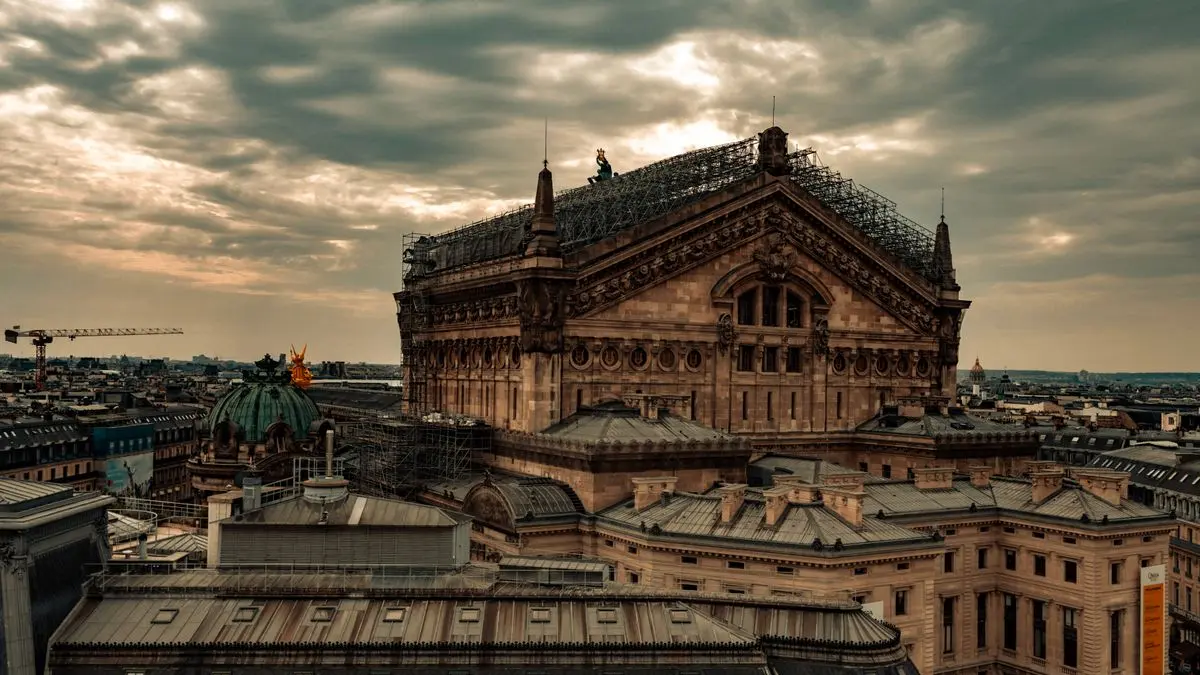
Throwing open the shutters onto the gilded façade of the Palais Garnier is a promise that stirs the imagination and weighs heavily when you come to book. But what does a room with an Opéra view actually mean? Not all views are equal, and the phrase covers very different realities. Here is how to decode the listings, filter your search by outlook, and pinpoint the streets that frame Charles Garnier’s masterpiece most handsomely.
What an Opéra view really means
The phrase is seductive but elastic. A room with a view of the Opéra can mean a window looking straight onto the main façade of the Palais Garnier, or simply a sideways glimpse in which you can just make out, between two rooftops, the verdigris dome and the golden Apollo that crowns it. Between those extremes lies an endless range of gradations that no listing spells out on its own.
It also helps to distinguish the frontal view, over the Place de l’Opéra and the grand outdoor staircase, from a view along the building’s flanks, down the Rue Scribe or the Rue Auber, or from the rear on the Rue Halévy, where the architecture turns more intimate. Each tells the monument differently: the first for its majesty, the others for the detail of the sculptures and the low evening light.
Finally, height changes everything. From an upper floor the eye rises above the traffic to take in the roofline, the bronze statues and, on occasion, the sunset behind the dome. From a raised ground floor the view often reduces to the boulevard traffic. The wording alone is never enough: it is the floor, the orientation and the clear sightline that make the panorama.
The monument you will be looking at
Knowing what you are about to admire helps you choose. Opened in 1875, the Opéra Garnier is the work of the architect Charles Garnier, who won the competition launched under the Second Empire. Its main façade, facing the Place de l’Opéra, unfolds a profusion of columns, busts of composers and sculpted groups, among them a copy of Carpeaux’s The Dance. This is the face travellers hope to see from their window.
At the summit, the weathered copper dome, greened by time, carries an Apollo raising his lyre. On the slopes, the gilded figures of Poetry and Harmony catch the sun and signal the monument from far off. Inside, out of sight but worth knowing, the celebrated ceiling painted by Marc Chagall in 1964 crowns the main auditorium: one more reason to step through the doors after admiring the exterior.
From a well-placed room it is chiefly the rooftops and the sculptures you savour, in a light that shifts through the hours. Morning lights the façade head-on; evening sets the gilding ablaze and lengthens the shadows across the stone. Many travellers discover that the finest view is not necessarily the most frontal, but the one that catches this light.
The streets and sightlines that matter
Around the Palais Garnier, geography shapes the best outlooks. The Place de l’Opéra, at the head of the Avenue de l’Opéra, offers the most dramatic axis: it is from here, in a straight line up from the Louvre, that the façade reveals itself in full symmetry. Addresses giving onto this square, or onto the first stretch of the adjoining streets, enjoy the most direct panorama.
Along the sides, the Rue Scribe and the Rue Auber run beside the building’s flanks and frame the dome at a more graphic angle much prized by photographers. To the rear, the Rue Halévy and the Rue Gluck open up more confidential glimpses, often from upper floors. The nearby Boulevard des Capucines and Boulevard Haussmann sometimes offer oblique views where the Opéra appears at the corner of your eye.
This web of streets explains why a single district can offer radically different views. A quiet street set slightly back does not rule out a fine outlook: all it takes is a clear sightline along the axis and a high enough floor. Conversely, a seemingly ideal address can be masked by an adjoining building. The street alone guarantees nothing; it is the blend of street, floor and orientation that decides.
How to filter your search by view
On booking platforms, the view is worth treating as a criterion in its own right. Look for room categories that mention it explicitly (a monument view, an Opéra view, a view over the square) rather than trusting the hotel’s location alone. An address next door to the Palais Garnier does not mean its rooms face it.
Read the room names methodically: a room advertised on a high floor, facing the right side, stands a far better chance of offering a genuine panorama than a standard category with no detail. Study the photographs, seeking the real angle of the window, the presence of anything opposite and the clearance. A picture taken from the balcony is worth more than a general shot from the hotel roof, which is not the view from your room.
Do not hesitate to contact the hotel to confirm the orientation, the floor and the extent of the clear sightline before paying a view supplement. Rates for these rooms vary with the season and are best checked in real time; compare on equal category and location. Bear in mind, too, that a coveted view often comes with street life below: double glazing and a high floor reconcile the panorama with peaceful nights.
Beyond the window: living the district
Choosing a room with a view also means anchoring yourself in one of the liveliest districts of Paris. The Palais Garnier opens onto the Boulevard Haussmann and its department stores, among them the Galeries Lafayette, crowned since 1912 by a spectacular Art Nouveau stained-glass dome that alone justifies the climb to the panoramic terraces.
A few steps away stretch the Grands Boulevards, with their theatres and their nineteenth-century covered passages, as well as the Musée Grévin and its gallery of waxworks. To the south, the Avenue de l’Opéra runs straight towards the Louvre, while the Place Vendôme and its jewellers are only minutes away. The Saint-Lazare and Gare du Nord stations, essential for wider excursions, remain close at hand.
The transport links complete the appeal of this base: métro lines 3, 7, 8 and 9 all cross around the Opéra, supported by the RER and a dense network of buses. From your window opening onto Garnier’s dome, the whole city lies within walking reach. Perhaps that is the true luxury of an Opéra view: pairing an exceptional panorama with the beating heart of Paris at your feet.